[Last Updated: April 1, 2026]
What happens when a freelancer earns $100,000 in net profit and discovers that roughly $14,130 goes straight to the IRS — before federal income tax is even calculated? That figure is the self-employment tax, and it catches millions of independent workers off guard every filing season.
For the 2026 tax year, the self-employment tax rate remains at 15.3%, but the Social Security wage base has climbed to $184,500, meaning higher-earning sole proprietors, gig workers, and independent contractors will owe more in total than in previous years. The One Big Beautiful Bill Act (OBBBA), signed into law on July 4, 2025, also introduced several major changes — including a permanent Qualified Business Income (QBI) deduction and higher 1099 reporting thresholds — that every self-employed filer needs to understand before the next quarterly estimated payment comes due.
Here at startaxoffice.org, the goal is to break down exactly how this tax works, what changed, and which strategies can legally reduce the bill. No jargon walls, no vague generalities — just the numbers, the deadlines, and the facts, based on current IRS guidelines.
Key Takeaways
- The self-employment tax rate for 2026 is 15.3% (12.4% Social Security + 2.9% Medicare), applied to 92.35% of net self-employment earnings — not the full amount.
- The Social Security wage base increased to $184,500 for 2026, up from $176,100 in 2025, raising the maximum possible self-employment tax.
- The OBBBA made the 20% QBI deduction permanent, raised the 1099-NEC reporting threshold to $2,000, and restored 100% bonus depreciation.
- Quarterly estimated tax payments for 2026 are due April 15, June 15, September 15, and January 15, 2027 — missing these can trigger IRS underpayment penalties.
- Only deductions taken on Schedule C directly reduce self-employment tax; above-the-line deductions like the 50% SE tax deduction and health insurance premiums reduce income tax, not SE tax itself.
What Is Self-Employment Tax and Who Owes It in 2026?
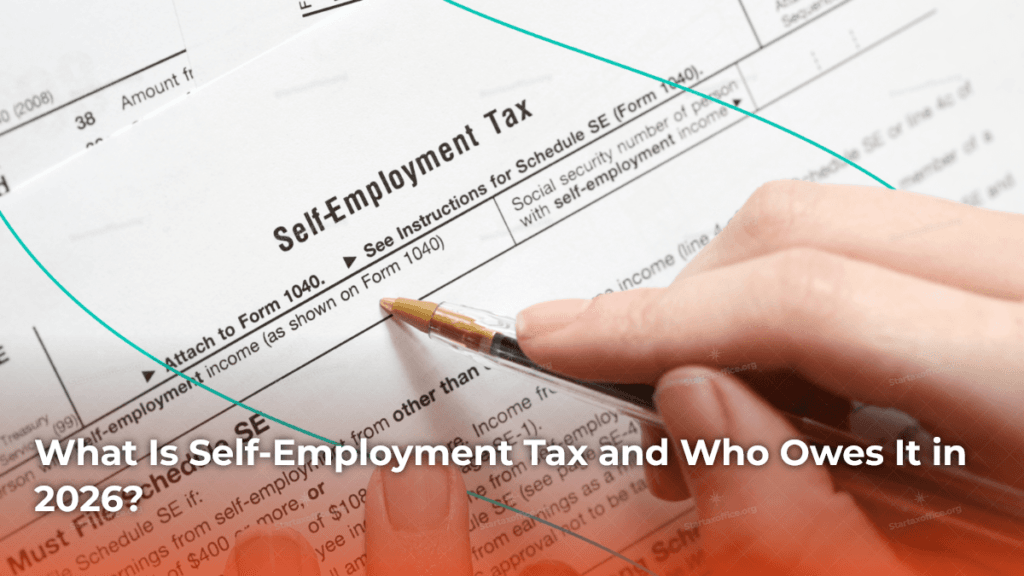
Self-employment tax is the way independent workers pay into Social Security and Medicare — the same programs funded through FICA withholding on W-2 paychecks. The critical difference is that W-2 employees split the cost with an employer (each paying 7.65%), while self-employed individuals cover the full 15.3% alone.
According to the IRS, any individual with net self-employment earnings of $400 or more must file Schedule SE and pay this tax. It applies regardless of age — even retirees collecting Social Security benefits owe self-employment tax on qualifying earnings.
The 15.3% Rate Breakdown — Social Security and Medicare
The 15.3% self-employment tax rate consists of two components, as of the 2026 tax year:
| Component | Rate | Applies To |
|---|---|---|
| Social Security (OASDI) | 12.4% | First $184,500 of net SE earnings |
| Medicare (HI) | 2.9% | All net SE earnings (no cap) |
| Total Self-Employment Tax | 15.3% | Applied to 92.35% of net SE earnings |
Source: IRS.gov — Self-Employment Tax. Figures correct as of April 2026. Tax rates and thresholds are subject to change based on annual IRS inflation adjustments and legislative updates.
The 12.4% Social Security portion has a cap — once combined wages and self-employment earnings reach $184,500, no additional Social Security tax applies. Medicare, however, has no ceiling and applies to every dollar of net self-employment earnings.
The $400 Net Earnings Threshold
The IRS requires anyone with net self-employment earnings of $400 or more to file Schedule SE with Form 1040 or Form 1040-SR. This threshold applies whether the income comes from freelance writing, rideshare driving, consulting, online sales, or any other self-employed activity.
Worth noting: the $400 threshold applies to net earnings — meaning gross income minus allowable business expenses reported on Schedule C. A freelancer who earns $10,000 in gross revenue but has $9,700 in legitimate business expenses ($300 net profit) would fall below the threshold and owe no self-employment tax.
How Self-Employment Tax Is Actually Calculated (Step by Step)
A common misconception floating around social media and online forums is that the IRS applies the full 15.3% to every dollar of freelance income. The actual calculation involves a specific multiplier that most online tax guides either gloss over or explain poorly.
Why the IRS Only Taxes 92.35% of Net Earnings
Here’s the deal: when an employer pays the 7.65% FICA match for a W-2 employee, that employer portion is deductible as a business expense. To provide a roughly equivalent benefit to self-employed workers, the IRS allows a deduction of 7.65% before calculating self-employment tax.
The result is that only 92.35% of net self-employment earnings (100% minus 7.65%) is subject to the 15.3% rate. This is not a special deduction that needs to be claimed — it is built directly into the Schedule SE calculation on Line 4a.
A Real Calculation Example on $100,000 Net Profit
A step-by-step example makes the math concrete. Suppose a freelance graphic designer reports $100,000 in net profit on Schedule C after deducting all legitimate business expenses.
| Step | Calculation | Amount |
|---|---|---|
| 1. Net profit from Schedule C | Gross income minus business expenses | $100,000 |
| 2. SE tax base (92.35%) | $100,000 × 0.9235 | $92,350 |
| 3. Social Security portion (12.4%) | $92,350 × 0.124 | $11,451.40 |
| 4. Medicare portion (2.9%) | $92,350 × 0.029 | $2,678.15 |
| 5. Total SE tax | $11,451.40 + $2,678.15 | $14,129.55 |
| 6. Deductible half (50%) | $14,129.55 × 0.50 | $7,064.78 |
Source: IRS Schedule SE instructions. Figures correct as of April 2026.
So on $100,000 of net freelance profit, the self-employment tax alone comes to approximately $14,130. That amount is owed on top of federal income tax — and on top of any applicable state income tax.
The $7,064.78 deductible half (Step 6) is an above-the-line deduction that reduces adjusted gross income (AGI) on Form 1040. It lowers the income tax bill, but it does not reduce the self-employment tax itself.
The Social Security Wage Base Just Increased to $184,500
For the 2026 tax year, the Social Security wage base rose to $184,500 — up from $176,100 in 2025 and $168,600 in 2024. This means the maximum Social Security tax from self-employment income alone is now higher than ever.
| Tax Year | SS Wage Base | Max SE Tax at Cap |
|---|---|---|
| 2024 | $168,600 | $25,795.80 |
| 2025 | $176,100 | $26,943.30 |
| 2026 | $184,500 | $28,228.50 |
Source: IRS.gov and Bradford Tax Institute. Figures correct as of April 2026. Tax rates and thresholds are subject to change based on annual IRS inflation adjustments and legislative updates.
The “Max SE Tax at Cap” column reflects the combined 15.3% on the full wage base ($184,500 × 15.3% = $28,228.50). Any net SE earnings above $184,500 remain subject to the 2.9% Medicare tax — and potentially the Additional Medicare Tax as well.
For self-employed individuals who also hold a W-2 job, the $184,500 cap applies to combined wages and net SE earnings. If a taxpayer earns $150,000 in W-2 wages, only the first $34,500 of net SE earnings would be subject to the 12.4% Social Security portion.
The Additional 0.9% Medicare Surtax Most Filers Overlook
Beyond the standard 2.9% Medicare component of self-employment tax, higher-earning filers face an additional 0.9% Medicare surtax. This surtax was introduced by the Affordable Care Act and applies to combined wages and self-employment income that exceed specific thresholds.
Interestingly, the IRS does not withhold this surtax from estimated payments automatically — it is the filer’s responsibility to account for it when calculating quarterly payments. Failing to include it can lead to an unexpected bill at filing time.
Income Thresholds by Filing Status
| Filing Status | Threshold | Additional Rate |
|---|---|---|
| Single | $200,000 | 0.9% |
| Married Filing Jointly | $250,000 | 0.9% |
| Married Filing Separately | $125,000 | 0.9% |
| Head of Household | $200,000 | 0.9% |
| Qualifying Surviving Spouse | $250,000 | 0.9% |
Source: IRS.gov — Questions and Answers for the Additional Medicare Tax. Figures correct as of April 2026.
These thresholds are not indexed for inflation, which means more self-employed filers cross them each year as incomes rise. A single freelancer earning $250,000 in net SE income would owe the standard 2.9% Medicare tax on all earnings, plus an extra 0.9% on the $50,000 above the $200,000 threshold — an additional $450 in tax.
What Changed for Self-Employed Taxpayers in 2026 Under the OBBBA
The One Big Beautiful Bill Act (OBBBA), signed into law on July 4, 2025, introduced the most significant tax code changes since the Tax Cuts and Jobs Act of 2017. While the self-employment tax rate itself did not change, several provisions directly affect how self-employed individuals calculate taxable income and plan for tax obligations.
The QBI Deduction Is Now Permanent
The Section 199A Qualified Business Income (QBI) deduction — which allows eligible self-employed individuals, sole proprietors, and owners of pass-through entities to deduct up to 20% of qualified business income — was scheduled to expire after the 2025 tax year. The OBBBA made it permanent.
In addition to permanence, the OBBBA introduced two notable improvements. First, the income phase-in thresholds where limitations begin were expanded to $75,000 for single filers and $150,000 for married couples filing jointly (up from $50,000 and $100,000 previously). Second, a new minimum QBI deduction of $400 now applies to any taxpayer with at least $1,000 in qualified business income from an active trade or business in which they materially participate.
Keep in mind, though: the QBI deduction reduces taxable income, not self-employment tax. It lowers the income tax bill, but the full SE tax still applies to 92.35% of net earnings.
1099-NEC Reporting Threshold Raised to $2,000
Starting in the 2026 tax year, businesses are not required to issue a 1099-NEC until payments to an independent contractor reach $2,000 — up from the long-standing $600 threshold. The same $2,000 threshold now applies to Form 1099-MISC as well.
A common belief circulating on Reddit and TikTok is that earnings below the new threshold are not taxable. That is incorrect. All self-employment income is reportable to the IRS regardless of whether a 1099 is received. The threshold change simply reduces the paperwork burden on businesses issuing the forms.
Additionally, the 1099-K reporting threshold reverted to the original pre-2022 standard: gross sales exceeding $20,000 and more than 200 transactions per year. The phased-in reduction to $600 that had been delayed multiple times was eliminated entirely by the OBBBA.
100% Bonus Depreciation Restored
The OBBBA restored 100% first-year bonus depreciation for qualifying business assets. This means self-employed individuals can deduct the entire cost of equipment, computers, vehicles (subject to limits), and other qualifying property in the year of purchase — rather than depreciating the cost over several years.
For freelancers and sole proprietors purchasing significant business assets in 2026, this provision can substantially reduce Schedule C net profit, which in turn directly lowers self-employment tax.
Schedule SE and Quarterly Estimated Payments — How to Stay Compliant
Self-employed individuals do not have an employer withholding taxes from each paycheck. Instead, the IRS expects taxes to be paid throughout the year via quarterly estimated payments using Form 1040-ES.
According to the Taxpayer Advocate Service, failing to make adequate estimated payments is one of the most common compliance issues among self-employed taxpayers — and it can result in penalties even when the annual return shows a refund.
2026 Quarterly Due Dates
The IRS divides the tax year into four unequal payment periods. Estimated payments that include both self-employment tax and federal income tax are due on the following dates for the 2026 tax year:
| Quarter | Income Period | Payment Due Date |
|---|---|---|
| Q1 | January 1 – March 31 | April 15, 2026 |
| Q2 | April 1 – May 31 | June 15, 2026 |
| Q3 | June 1 – August 31 | September 15, 2026 |
| Q4 | September 1 – December 31 | January 15, 2027 |
Source: IRS.gov — Estimated Tax for Individuals. Figures correct as of April 2026.
Notice that the “quarters” are not actually equal — Q2 covers only two months while Q4 covers four. Missing any deadline can trigger an underpayment penalty, even if the annual return ultimately shows a balance of zero or a refund.
Payments can be made through IRS Direct Pay, the Electronic Federal Tax Payment System (EFTPS), or by mailing Form 1040-ES payment vouchers.
The Safe Harbor Rule to Avoid Penalties
The IRS provides a safe harbor rule that protects filers from underpayment penalties. To qualify, estimated payments for the current year must meet one of two criteria:
- Pay at least 90% of the tax liability for the current year (2026), OR
- Pay at least 100% of the total tax shown on the prior year’s return (2025) — this rises to 110% if adjusted gross income exceeded $150,000 ($75,000 for Married Filing Separately)
For self-employed workers with unpredictable income — freelancers with seasonal clients, gig workers, or consultants between contracts — the prior-year safe harbor method is often the simpler and safer approach.
Five Strategies That Reduce the Tax Burden on Self-Employment Income
Not all deductions work the same way. Some reduce self-employment tax directly (by lowering Schedule C net profit), while others reduce only income tax (by lowering AGI or taxable income). Understanding the difference can save hundreds or even thousands of dollars annually.
The 50% SE Tax Deduction (Above-the-Line)
The IRS allows self-employed individuals to deduct 50% of the self-employment tax paid as an above-the-line adjustment on Form 1040, Schedule 1. On $14,130 in SE tax, the deductible amount is approximately $7,065.
Here’s the thing: this deduction reduces AGI, which lowers federal income tax — but it does not reduce the self-employment tax itself. It is calculated after the SE tax has already been determined on Schedule SE.
Retirement Contributions — Solo 401(k) and SEP IRA
Contributions to a Solo 401(k) or SEP IRA can significantly reduce taxable income for self-employed filers. For the 2026 tax year, the Solo 401(k) allows an employee deferral of up to $23,500 (plus an additional $7,500 catch-up contribution for those age 50 and older), combined with an employer contribution of approximately 25% of net self-employment income after the SE tax deduction — up to a total limit of $70,000.
A SEP IRA permits contributions of up to 25% of net self-employment earnings (after the 50% SE tax deduction), with the same $70,000 maximum. These contributions reduce taxable income and income tax but do not directly reduce the self-employment tax base.
That said, the income tax savings can be substantial. A freelancer contributing $23,500 to a Solo 401(k) in the 22% federal tax bracket would save $5,170 in federal income tax alone.
As of April 2026. Contribution limits are subject to change based on annual IRS inflation adjustments and legislative updates.
Health Insurance Premium Deduction
Self-employed individuals who pay health insurance premiums — and are not eligible to participate in a plan through a spouse’s employer — can deduct 100% of those premiums as an above-the-line deduction on Form 1040. This includes premiums for the filer, a spouse, and dependents.
This deduction reduces AGI and income tax. It does not reduce Schedule C net profit and therefore does not lower self-employment tax directly. However, with average individual health insurance premiums exceeding $7,000 per year in many states, the income tax savings alone make this deduction critical.
Home Office and Mileage (72.5 Cents per Mile in 2026)
Unlike the deductions above, the home office deduction and business mileage deduction are taken directly on Schedule C — which means they reduce net self-employment earnings and lower both self-employment tax and income tax.
The home office deduction can be calculated using the simplified method ($5 per square foot, up to 300 square feet, for a maximum deduction of $1,500) or the regular method (actual expenses proportional to the percentage of the home used exclusively and regularly for business).
For business mileage, the IRS standard mileage rate for 2026 is 72.5 cents per mile — a record high, up from 70 cents per mile in 2025. According to IRS Notice 2026-10, this rate applies to cars, vans, pickups, and panel trucks used for business purposes, including electric and hybrid vehicles. A freelancer who drives 15,000 business miles in 2026 could claim a $10,875 deduction on Schedule C, directly reducing both self-employment tax and income tax.
S-Corp Election — When It Makes Sense
Electing S-Corporation status is the most significant structural strategy for reducing self-employment tax on higher earnings. When a sole proprietorship or single-member LLC makes an S-Corp election (via Form 2553), the owner splits business income into two categories: W-2 salary (subject to FICA payroll taxes at 15.3%) and remaining profit distributions (not subject to self-employment tax).
For example, on $120,000 in net business profit, an S-Corp owner might pay a reasonable salary of $60,000 and take $60,000 as a distribution. The SE/FICA tax would only apply to the $60,000 salary — potentially saving over $9,000 compared to paying SE tax on the full amount as a sole proprietor.
The catch: the IRS requires S-Corp owners to pay “reasonable compensation” — a salary comparable to what the market would pay for the same services. Setting the salary too low is a common audit trigger. Additionally, S-Corp status requires payroll processing, a separate tax return (Form 1120-S), and additional accounting costs that typically run $1,500 to $3,000 per year. For self-employed individuals with net profit consistently below $60,000 to $80,000, the compliance costs may exceed the SE tax savings.
It may be worth consulting a qualified CPA or enrolled agent to run the specific numbers before making this election.
Common Myths About Self-Employment Tax
Misinformation about self-employment tax is widespread — from TikTok tax advice to Reddit threads to well-meaning but inaccurate blog posts. Addressing the most persistent myths can save filers from costly mistakes.
“The IRS Taxes 100% of Freelance Income at 15.3%”
In practice, the IRS only applies the 15.3% rate to 92.35% of net earnings, not the full amount. On $100,000 in net profit, the effective SE tax rate is approximately 14.13% ($14,130 on $100,000), not 15.3%. The 7.65% reduction is the IRS’s way of giving self-employed workers a benefit comparable to the employer-side FICA deduction that W-2 workers receive.
“Side Hustlers Under $600 Don’t Owe Anything”
A common belief is that side-hustle income below $600 (or $2,000 under the new 1099-NEC threshold) is not taxable. According to the IRS, all income is taxable regardless of whether a 1099 form is issued. The $2,000 threshold only determines when the payer is required to issue the form — not when the income becomes taxable.
A side hustler earning $500 from freelance work would still owe self-employment tax on that amount if net earnings exceed $400, and would still need to report the income on Schedule C.
“S-Corp Election Always Saves Money”
While S-Corp status can generate substantial SE tax savings at higher income levels, it is not a universal solution. The additional costs of payroll processing, Form 1120-S preparation, and state-level filing fees can easily total $2,000 to $3,000 per year. For sole proprietors with net profit under $60,000, those compliance costs frequently eat into — or exceed — the potential SE tax savings.
Individual circumstances vary significantly. A qualified CPA or enrolled agent can provide personalized guidance based on specific income levels, business structure, and state tax considerations.
Protecting Against Tax Fraud and Scams
Tax season brings a surge in fraud targeting self-employed individuals. The IRS has reported increases in phishing emails, phone scams from callers impersonating IRS agents, and “ghost” tax preparers who refuse to sign returns they prepare.
Self-employed filers should be aware that the IRS will never initiate contact by email, text message, or social media to request personal or financial information. Any legitimate IRS communication begins with a mailed letter or notice.
If a suspicious contact is received, or if a tax preparer refuses to provide a Preparer Tax Identification Number (PTIN) or sign the return, the following resources are available:
- IRS General Inquiries: 1-800-829-1040
- IRS Identity Theft Hotline: 1-800-908-4490
- Treasury Inspector General for Tax Administration (TIGTA): 1-800-366-4484
- FTC Fraud Reporting: reportfraud.ftc.gov
- IRS Identity Protection PIN (IP PIN): Available through IRS.gov to prevent unauthorized use of a Social Security Number on fraudulent tax returns
The Taxpayer Advocate Service also assists individuals who experience problems with the IRS that cannot be resolved through normal channels.
Disclaimer: The information on startaxoffice.org is for general informational purposes only and does not constitute tax, legal, or financial advice. Tax laws, rates, and filing requirements change frequently. Always consult a qualified tax professional, CPA, or enrolled agent before making tax decisions. This site is not affiliated with the IRS, any state tax authority, or any tax preparation company.
A Brief Note on State Taxes
Self-employment tax is a federal obligation, but most states impose their own income tax on self-employment earnings as well. Nine states — Alaska, Florida, Nevada, New Hampshire, South Dakota, Tennessee, Texas, Washington, and Wyoming — have no state income tax on earned income. For self-employed individuals in the remaining 41 states (and the District of Columbia), state income tax adds another layer to the total tax burden. State estimated payment schedules may also differ from the federal quarterly dates.
Sources
- IRS — Self-Employment Tax (Social Security and Medicare Taxes)
- IRS — Estimated Tax for Individuals
- IRS — 2026 Business Standard Mileage Rate
- Taxpayer Advocate Service — Estimated Payments
Frequently Asked Questions

Hendra Wijaya is the editor-in-chief and senior tax analyst at startaxoffice.org with over 20 years of experience in tax analysis, federal income tax filing, and IRS compliance. Holding an Enrolled Agent (EA) designation and a Master's in Accounting, Hendra leads the editorial team with a focus on delivering accurate, well-sourced tax content grounded in IRS.gov data and the Internal Revenue Code. A certified IRS Annual Filing Season Program (AFSP) holder, his coverage spans federal tax brackets, self-employment tax, audit procedures, and tax planning strategies for American taxpayers across all filing statuses.