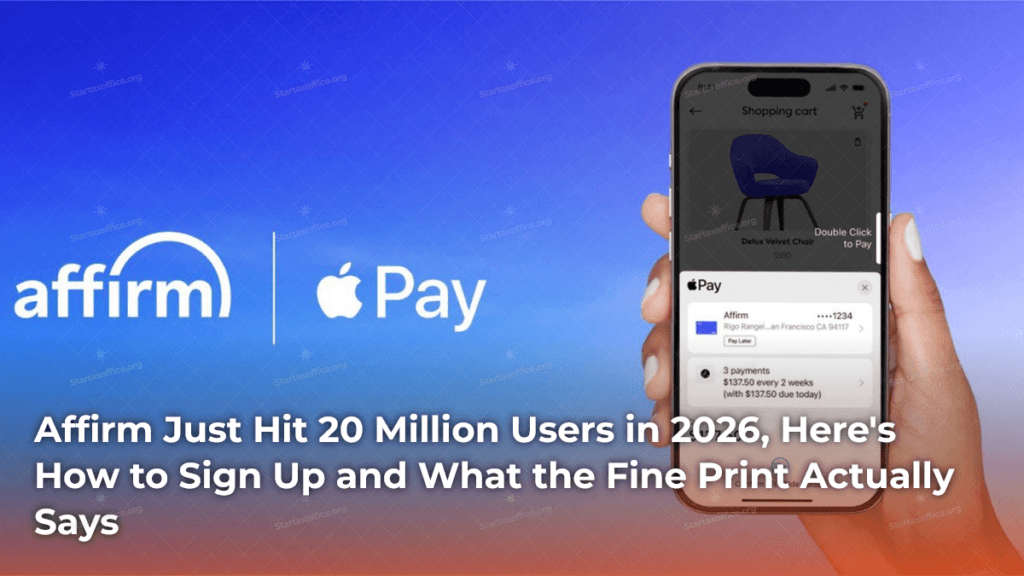
Has splitting a $400 purchase into four interest-free payments ever sounded too good to be true? For millions of Americans, buy now, pay later has become the go-to alternative to credit cards — and Affirm sits at the center of that shift.
As of December 2025, Affirm reported 25.8 million active consumers and 478,000 merchant partners, according to the company’s fiscal Q2 2026 earnings release. That’s a 23% jump in users year over year, making it the largest U.S.-based BNPL platform by active consumer count. But rapid growth doesn’t mean every detail is straightforward — and the fine print matters more than most online guides suggest. This article on startaxoffice.org breaks down exactly how the sign-up process works, what Affirm charges (and doesn’t), and the credit reporting changes that went into effect in 2025.
Here’s the thing: not every BNPL product is created equal. Some charge compound interest, hidden fees, or penalize late payments aggressively. Affirm’s model is different in several key areas — but that doesn’t mean there are zero risks.
Key Takeaways
- Affirm requires applicants to be at least 18 years old, have a valid U.S. address, a U.S. mobile number, and the last four digits of a Social Security Number
- APR ranges from 0% to 36% depending on creditworthiness, purchase amount, and merchant
- Affirm charges no late fees, no prepayment penalties, and no compound interest — ever
- Since April 2025, all Affirm pay-over-time loans are reported to Experian, and since May 2025, to TransUnion
- Checking eligibility uses a soft credit pull; accepting certain longer-term plans may trigger a hard inquiry
What Is Affirm and How Does It Work in 2026
Affirm is a point-of-sale lender founded in 2012 by Max Levchin, a co-founder of PayPal. The platform allows consumers to split purchases into fixed installments — either interest-free or at a stated APR — rather than paying the full amount upfront or revolving a credit card balance.
The Basics of Buy Now, Pay Later Through Affirm
The core concept is simple: select Affirm at a retailer’s checkout (online or in-store), get an instant lending decision, and choose a repayment plan. Affirm sends payment directly to the merchant, and the borrower repays Affirm in scheduled installments.
Payment options typically fall into a few categories:
- Pay in 4 — Four interest-free biweekly payments (0% APR), generally available for purchases between $50 and $250
- Monthly installments — Terms ranging from six weeks to 60 months, with APR from 0% to 36% based on creditworthiness and the merchant’s financing program
- Affirm Card — A Visa debit card (issued by Evolve Bank & Trust or Stride Bank, Members FDIC) that can be used anywhere Visa is accepted, with the option to split purchases into installments after the fact
Affirm uses simple interest, not compound interest. That means the total cost disclosed at checkout is the final cost — it never increases, even if a payment is late.
How Affirm Differs From Credit Cards and Other BNPL Apps
The biggest structural difference between Affirm and a traditional credit card is the absence of revolving debt. Each Affirm loan is a closed-end installment with a fixed payoff date, unlike a credit card balance that can grow indefinitely through compounding interest and minimum-payment traps.
Compared to competitors like Klarna and Afterpay, Affirm stands out in a few areas. Affirm offers longer repayment terms (up to 60 months at some merchants), charges $0 in late fees across all products, and — as of 2025 — reports all pay-over-time loans to two major credit bureaus. Klarna, by contrast, only reports certain longer-term loans to TransUnion and does not universally furnish Pay in 4 data. Afterpay charges late fees of up to $8 per missed payment.
| Feature | Affirm | Klarna | Afterpay |
|---|---|---|---|
| APR Range | 0%–36% | 0%–36% | 0% (Pay in 4 only) |
| Late Fees | $0 — Never | Varies by product | Up to $8 per missed payment |
| Max Loan Term | Up to 60 months | Up to 36 months | 6 weeks (4 payments) |
| Credit Bureau Reporting | Experian + TransUnion (all loans) | TransUnion (select loans only) | Limited |
| Interest Type | Simple interest | Simple interest | N/A (no interest) |
| Debit Card Product | Affirm Card (Visa) | Klarna Card | Not available |
Source: Company disclosures and terms pages. Figures correct as of April 2026. Features and terms are subject to change.
Step-by-Step Guide to Signing Up for Affirm
The registration process is designed to take under two minutes. There are two paths: creating an account through the Affirm app or website before shopping, or signing up directly at a merchant’s checkout.
Eligibility Requirements Before Applying
According to Affirm’s help center, the following requirements must be met to create an account:
- Be at least 18 years old (19 in Alabama, or if a ward of the state in Nebraska)
- Provide a valid U.S. or APO/FPO/DPO home address
- Have a valid U.S. mobile or VoIP phone number registered in the applicant’s name, with SMS capability
- Provide a full legal name, email address, date of birth, and the last four digits of a Social Security Number for identity verification
There is no minimum credit score disclosed by Affirm. The company uses its own proprietary model that evaluates multiple data points beyond just the FICO score, including purchase history on the platform, the specific merchant, and the size of the transaction.
The Actual Sign-Up Process From Start to Finish
Signing up through the Affirm app or at affirm.com/user/signup follows this sequence:
- Download the Affirm app (available on the App Store and Google Play) or visit the sign-up page at affirm.com
- Enter a mobile phone number and verify it via a one-time SMS code
- Provide full legal name, email, date of birth, and the last four digits of a Social Security Number (SSN)
- Agree to Affirm’s terms of service and privacy policy
- The system runs an instant identity verification — this is a soft credit inquiry that does not affect credit scores
Alternatively, first-time users can sign up directly at a participating merchant’s checkout page. During checkout, selecting Affirm as the payment method triggers the same registration flow, and the lending decision typically comes within 10 to 12 seconds.
What Happens After the Application Is Submitted
Once the account is created, Affirm assigns a “Purchasing Power” estimate — an approximate spending limit across the platform. This figure is not a guaranteed approval amount; actual approval depends on the specific purchase, the merchant, and the applicant’s financial profile at the time of checkout.
For each transaction, Affirm presents between one and three payment plan options. These may include a Pay in 4 plan at 0% APR, a monthly installment plan at a stated interest rate, or both. A down payment may be required on certain purchases.
Worth noting: being approved for one purchase does not guarantee approval for the next. Affirm evaluates each transaction independently.
What the Fine Print Says About Interest Rates and Fees
This is where many online guides fall short. The headline “0% interest” applies to some Affirm products — but not all.
Affirm’s APR Range and How It Gets Determined
Affirm’s APR ranges from 0% to 36%, based on several factors:
- The applicant’s credit score and credit history
- Payment history on previous Affirm loans (if any)
- The specific merchant’s financing program — some retailers subsidize 0% APR offers
- The purchase amount and selected repayment term
- How long the applicant has held an Affirm account
For a concrete example: a $400 purchase might result in a $80 down payment followed by 12 monthly payments of $28.88 at 15% APR, or four interest-free biweekly payments of $100. The borrower sees both options and chooses one before committing.
According to Affirm’s disclosures, approximately 43% of loans facilitated through the platform carry a 0% APR. For borrowers with average credit scores in the 600–700 range, rates of 15% to 25% are common. Those with subprime credit may see rates closer to the 36% cap.
| Credit Profile | Typical APR Range | Common Loan Terms |
|---|---|---|
| Strong credit (720+) | 0%–10% | Pay in 4, 6–24 months |
| Good credit (660–719) | 10%–20% | 3–36 months |
| Fair credit (600–659) | 20%–30% | 3–12 months |
| Subprime credit (below 600) | 30%–36% | 3–12 months (if approved) |
Source: Affirm disclosures and third-party analysis. APR ranges are estimates and will vary by merchant, purchase, and individual creditworthiness. Figures correct as of April 2026 and subject to change.
Late Fees, Hidden Charges, and What Most Users Miss
Affirm’s most frequently cited selling point is its $0 late fee policy. According to the company’s FY2025 Impact Report, Affirm has never charged a late fee in its history — across all 25.8 million active consumers.
There are also no annual fees, no prepayment penalties, and no deferred interest traps (a common feature of store credit cards where 0% APR retroactively converts to a high rate if the balance isn’t paid in full).
So what’s the catch? A few things most casual guides overlook:
- Interest on longer-term plans can be significant. A $1,000 purchase at 30% APR over 12 months results in roughly $166 in total interest — not trivial.
- Refund policies are merchant-dependent. If an item is returned, the merchant processes the refund, but any interest already paid on an Affirm loan is not refunded.
- Affirm may report late payments to Experian and TransUnion after 30 days. While there’s no late fee, the credit impact of a missed payment can be far more costly long-term.
- A down payment may be required on certain transactions, reducing the amount financed but still requiring an upfront cash outlay.
How Affirm Affects Credit Scores
The credit reporting landscape for buy now, pay later shifted dramatically in 2025, and Affirm was at the center of that change.
Soft Pull vs Hard Pull During Sign-Up
Creating an Affirm account, checking eligibility, and viewing Purchasing Power all use a soft credit inquiry — these do not appear on a credit report and have zero impact on credit scores.
However, if a borrower accepts a longer-term monthly installment plan, Affirm may perform a hard credit inquiry. According to Credible’s April 2026 review, a hard inquiry could lower a credit score by up to 10 points for as long as one year. Pay in 4 loans do not trigger a hard pull.
Does Affirm Report to the Three Major Credit Bureaus
As of 2025, Affirm reports all pay-over-time loans — including Pay in 4 — to both Experian (since April 1, 2025) and TransUnion (since May 1, 2025). This was announced through formal partnerships with both bureaus.
The key nuance: while the data now appears on consumer credit files, it is not yet factored into traditional FICO or VantageScore credit scores. The information is tagged separately and is currently visible only to consumers reviewing their own reports — not to lenders evaluating credit applications.
That said, FICO CEO William Lansing confirmed during a 2025 earnings call that FICO has been working with Affirm to explore incorporating BNPL data into future scoring models. TransUnion research found that 53% of consumers who haven’t used BNPL would be more likely to try it if the data could positively affect their credit score.
Put simply: on-time Affirm payments won’t boost a traditional credit score today, but they may in the near future. Late or missed payments, however, could still cause damage once reporting standards evolve — making responsible repayment essential from day one.
Affirm does not currently report to Equifax.
Common Mistakes to Avoid When Using Affirm
Even a no-late-fee product can create financial strain if misused. A 2025 LendingTree survey found that 41% of BNPL users paid late on at least one loan in the prior 12 months — up from 34% the year before.
Some of the most common pitfalls include:
- Stacking multiple BNPL loans simultaneously. Because BNPL debt often doesn’t appear on traditional credit reports (or isn’t yet scored), it’s easy to take on more than is manageable. Mortgage lenders, auto lenders, and credit card issuers may not see BNPL obligations when assessing a borrower’s total debt load — but the payments are still due.
- Ignoring the APR on monthly plans. The 0% headline attracts attention, but roughly 57% of Affirm loans carry some interest. Failing to compare the total cost against a high-yield savings account’s opportunity cost or a 0% intro APR credit card is a missed step.
- Assuming approval for one purchase guarantees the next. Each Affirm checkout is evaluated independently. Denial is possible even for existing users.
- Not budgeting for biweekly Pay in 4 payments. Four payments in eight weeks is a faster repayment pace than many consumers realize — roughly twice the speed of a standard monthly billing cycle.
- Forgetting the tax implications. If an item purchased through Affirm is used for business purposes, the deductible amount is the total purchase price — not just the payments made in a given tax year. Self-employed taxpayers should track these transactions carefully for Schedule C reporting. A CPA or enrolled agent can provide guidance on deduction timing.
When Affirm Makes Sense and When It Doesn’t
Not every purchase warrants a BNPL loan. Affirm works best in specific scenarios — and can create unnecessary risk in others.
Affirm may be a reasonable option when:
- A 0% APR Pay in 4 or promotional installment plan is available, effectively providing a short-term interest-free loan
- The purchase is planned and budgeted, not an impulse buy
- A credit card isn’t available or carries a higher APR than what Affirm offers
- The borrower wants a fixed payoff date rather than open-ended revolving debt
Affirm may not be the best fit when:
- The APR offered exceeds the rate on an existing credit card — some credit cards offer 0% introductory APR periods of 15 to 21 months, far longer than Affirm’s typical terms
- The item can be paid for in cash without financial strain
- Multiple BNPL loans are already active, creating a “phantom debt” problem invisible to other lenders
- The purchase is for a consumable or depreciating item where financing adds cost without lasting value
Bottom line: Affirm is a financial tool, not free money. Treating it as the latter is how BNPL debt spirals begin.
How to Report Problems and Protect Against Fraud
Affirm uses two-factor authentication and encryption during the sign-up and payment process. Borrowers are not held responsible for unauthorized purchases, and the company maintains a dedicated team for fraud investigations.
If a dispute arises that can’t be resolved with the merchant, Affirm can open a formal investigation. Payments on the disputed loan are paused during the process. Both parties have 15 days to present evidence, and Affirm issues a decision within 15 days (or up to 90 days for Affirm virtual card transactions).
For broader consumer protection concerns related to BNPL, the following contacts and resources may be useful:
- Consumer Financial Protection Bureau (CFPB) — consumerfinance.gov — The CFPB monitors BNPL lending practices, although its 2024 interpretive rule classifying BNPL as credit cards was withdrawn by the current administration in May 2025
- Federal Trade Commission (FTC) — reportfraud.ftc.gov — For reporting deceptive financial practices
- State Attorney General — Each state’s AG office can investigate consumer complaints against BNPL providers
- New York residents: New York enacted the Buy Now Pay Later Act in 2025, requiring BNPL providers to obtain a state license from the NYDFS. Proposed rules are currently under development as of early 2026.
Keep in mind: while the federal CFPB has deprioritized BNPL enforcement under the current administration, state-level regulation is expanding. Individual circumstances vary, and consulting a qualified financial advisor is recommended for significant lending decisions.
Disclaimer: The information on startaxoffice.org is for general informational purposes only and does not constitute tax, legal, or financial advice. Tax laws, rates, and filing requirements change frequently. Always consult a qualified tax professional, CPA, or enrolled agent before making tax decisions. This site is not affiliated with the IRS, any state tax authority, or any tax preparation company. BNPL terms, APR ranges, and credit reporting practices referenced in this article are based on publicly available disclosures as of April 2026 and are subject to change.
For consumers weighing the decision to sign up for Affirm, the platform’s transparency around pricing — no late fees, no compound interest, and upfront total-cost disclosure — puts it ahead of many alternatives. But transparency doesn’t eliminate risk, especially for those juggling multiple installment plans or accepting higher-APR offers without comparing alternatives.
A practical next step: before committing to any BNPL loan, checking a free credit report at annualcreditreport.com and comparing the offered APR against existing credit products can help ensure the decision is financially sound.
Sources
- Affirm — How It Works
- Affirm — Consumer Terms and Disclosures
- Affirm — Credit Reporting Information
- Affirm Investor Relations — FQ2 2026 Earnings
- CFPB — The Buy Now, Pay Later Market
- Credible — Affirm Personal Loans Review (April 2026)
Frequently Asked Questions

Fajar Pratama is a banking and credit writer at startaxoffice.org with over six years of experience covering personal finance, credit scores, banking products, and borrowing strategies. An Accredited Financial Counselor (AFC) candidate and holder of the American Bankers Association (ABA) Certificate in Consumer Credit, Fajar focuses on helping American consumers make informed decisions about personal loans, student loans, credit cards, and savings accounts. His writing is grounded in data from the Consumer Financial Protection Bureau (CFPB), FDIC, and Federal Reserve — ensuring every article meets the highest standard of accuracy and trustworthiness.