[Last Updated: April 4, 2026]
What would $10,000 in a high-yield savings account actually become in five years — not the vague “it grows over time” promise, but the real, dollar-for-dollar number after compound interest does its work?
Most savers know that compound interest exists, but far fewer understand just how dramatically it affects long-term growth — or how much the compounding frequency and monthly contributions change the final outcome. For 2026, with high-yield savings accounts still offering rates above 4% APY and the Federal Reserve’s benchmark rate influencing returns across the board, the math is worth running. The free compound interest calculator on startaxoffice.org below is built on the same standard amortization formulas used by major financial institutions, with real-time results that show exactly how an initial deposit, regular contributions, and compounding frequency combine to grow a balance over time.
The goal is straightforward — plug in a few numbers and see where every dollar ends up, year by year.
Key Takeaways
- Compound interest earns interest on both the original deposit and all previously accumulated interest — creating exponential growth over time.
- The compounding frequency matters: daily compounding produces a slightly higher return than monthly or annual compounding at the same rate.
- Even modest monthly contributions — $50 or $100 — can significantly increase the total balance over five to 10 years.
- This calculator automatically flags projected balances that approach or exceed the $250,000 FDIC insurance limit, helping savers plan deposit coverage accordingly.
- All calculations are based on standard compound interest formulas and are for estimation purposes only — actual returns depend on rate changes and account terms.
Why Compound Interest Is the Most Powerful Force in a Savings Account
Here’s the thing — a savings account earning 4% does not simply add 4% once at the end of the year. With daily compounding, that 4% annual rate translates into a tiny fraction of interest applied every single day, and each day’s interest gets folded back into the balance before the next day’s calculation runs.
Over short periods, the difference between simple and compound interest is barely noticeable. Over 10 or 20 years, it’s thousands of dollars. A $10,000 deposit at 4% compounded daily for 10 years — with no additional contributions — grows to approximately $14,918. Add just $100 per month, and that number jumps to roughly $29,649.
That gap is exactly what the calculator below is designed to reveal.
How the Compound Interest Calculator Works
What Each Input Field Means
The calculator requires five inputs.
Initial Deposit is the starting amount placed into the savings account, CD, or investment. This is the principal on which all compound interest calculations begin.
Monthly Contribution is the amount added to the account each month. Even small, consistent contributions have an outsized impact on long-term growth due to the compounding effect. Entering $0 is perfectly valid for one-time deposits like CDs.
Annual Interest Rate is the nominal annual rate offered by the financial institution. Most high-yield savings accounts advertise this as APY. The calculator treats the entered rate as the base annual rate and computes the effective APY based on the selected compounding frequency.
Time Period is the number of years the money will remain in the account earning interest.
Compounding Frequency determines how often interest is calculated and added to the balance. Daily compounding — the most common frequency for savings accounts — is the default. Other options include monthly, quarterly, semiannually, and annually.
What the Results Show
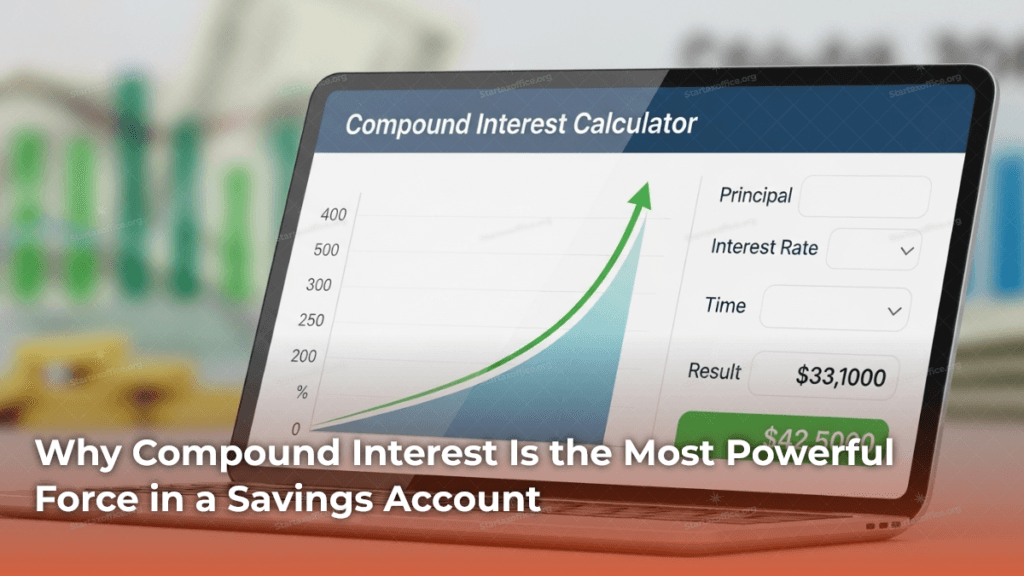
After entering the inputs, the results panel displays three key figures — total balance, total deposits, and total interest earned. A visual bar shows the proportion of the final balance that came from deposits versus interest.
Below the main results, a year-by-year growth breakdown illustrates how the balance expands over time. The stacked bars make it easy to see the compounding effect accelerate in later years — a pattern often called the “hockey stick” of compound growth.
The effective APY is displayed at the bottom, showing the true annual return after accounting for the selected compounding frequency. A 4% rate compounded daily, for example, produces an effective APY of approximately 4.08%.
If the projected balance exceeds $200,000, a note about FDIC deposit insurance coverage appears automatically. Balances above $250,000 trigger a more prominent alert — a reminder that the standard FDIC insurance limit is $250,000 per depositor, per bank, per ownership category.
What This Calculator Does Not Include
This tool estimates growth based on a fixed interest rate for the entire period. It does not account for variable rate changes, which are common with savings accounts as the Federal Reserve adjusts its benchmark rate. Taxes on earned interest — which the IRS requires to be reported as income — are also not factored in. Savers who earned interest from a savings account in 2025 should be aware that every dollar of that interest must be reported on the 2026 tax return.
Fees, early withdrawal penalties (for CDs), and inflation adjustments are not included. For personalized guidance on savings strategy, consulting a qualified financial advisor is recommended.
How Compounding Frequency Affects Real Returns
The following table illustrates how the same $10,000 deposit at a 4% annual rate produces different results depending on how often interest compounds — all over a five-year period with no additional contributions.
| Compounding Frequency | Final Balance | Interest Earned | Effective APY |
|---|---|---|---|
| Daily (365×/year) | $12,214 | $2,214 | 4.08% |
| Monthly (12×/year) | $12,210 | $2,210 | 4.07% |
| Quarterly (4×/year) | $12,202 | $2,202 | 4.06% |
| Annually (1×/year) | $12,167 | $2,167 | 4.00% |
Source: Calculated using standard compound interest formula A = P(1 + r/n)<sup>nt</sup>. Figures correct as of April 2026. Actual returns depend on account terms and rate changes.
The difference between daily and annual compounding on $10,000 over five years is roughly $47. On larger balances or longer time horizons, that gap widens considerably.
Disclaimer: The information on startaxoffice.org is for general informational purposes only and does not constitute tax, legal, or financial advice. Tax laws, rates, and filing requirements change frequently. Always consult a qualified tax professional, CPA, or enrolled agent before making tax decisions. This site is not affiliated with the IRS, any state tax authority, or any tax preparation company.
Sources
- FDIC — Deposit Insurance Coverage
- Federal Reserve — Selected Interest Rates
- Investor.gov — Compound Interest Calculator
Frequently Asked Questions
1 What is compound interest?
2 How often do savings accounts compound interest?
3 What is the difference between APR and APY?
4 Does the FDIC insure all savings account balances?
5 Is interest earned on a savings account taxable?

Fajar Pratama is a banking and credit writer at startaxoffice.org with over six years of experience covering personal finance, credit scores, banking products, and borrowing strategies. An Accredited Financial Counselor (AFC) candidate and holder of the American Bankers Association (ABA) Certificate in Consumer Credit, Fajar focuses on helping American consumers make informed decisions about personal loans, student loans, credit cards, and savings accounts. His writing is grounded in data from the Consumer Financial Protection Bureau (CFPB), FDIC, and Federal Reserve — ensuring every article meets the highest standard of accuracy and trustworthiness.