[Last Updated: April 4, 2026]
What happens when the cost of putting food on the table rises sharply — but the government benefit designed to help cover that cost was set six months earlier, based on prices that no longer exist?
That’s the situation facing roughly 42 million Americans who rely on the Supplemental Nutrition Assistance Program in spring 2026. When SNAP allotments were locked in for fiscal year 2026 on October 1, 2025, the national average for a gallon of gas was hovering near $2.76, grocery inflation was showing signs of cooling, and the conflict that would shut down the Strait of Hormuz hadn’t started yet — as startaxoffice.org has been tracking alongside other cost-of-living shifts affecting American households this year.
Now, with gas prices surging past $4 a gallon in the wake of the Iran war, diesel topping $5, and food-at-home prices climbing 2.4% year over year according to the Bureau of Labor Statistics, the gap between what SNAP provides and what groceries actually cost has widened to a level not seen since the peak of post-pandemic inflation in 2022. The average SNAP recipient gets about $6.17 per day to cover all meals — and that number won’t change until at least October 2026.
Key Takeaways
- SNAP maximum allotments for fiscal year 2026 were set in October 2025, before the Iran war triggered a 30%+ gas price surge and accelerating grocery inflation.
- The average SNAP benefit per person is approximately $188 per month — about $6.17 per day — while the USDA’s own moderate-cost food plan estimates a family of four needs roughly $1,430 per month for groceries.
- Diesel prices crossed $5.45 per gallon nationally, directly increasing the cost of growing, processing, and transporting food across the U.S.
- The One Big Beautiful Bill Act, signed July 4, 2025, froze any additional Thrifty Food Plan cost reevaluation through at least October 2027 and expanded SNAP work requirements to adults ages 55–64.
- SNAP households can take steps now — including maximizing deductions, stacking benefits with WIC and TEFAP, and accessing local SNAP match programs — to help bridge the gap while waiting for the next COLA adjustment.
SNAP Recipients Are Paying More for Groceries but Getting the Same Monthly Benefit
Between October 2025 and April 2026, the cost landscape for American households shifted dramatically. SNAP benefit amounts, however, did not move at all — because the program’s annual adjustment cycle doesn’t allow for mid-year corrections.
$994 a Month for a Family of Four Sounded Reasonable — Six Months Ago
The maximum SNAP allotment for a four-person household in the 48 contiguous states and Washington, D.C., is $994 per month for fiscal year 2026, effective from October 1, 2025, through September 30, 2026. That figure is based on the USDA’s Thrifty Food Plan, which calculates the cost of a nutritious, home-prepared diet at minimal expense using food prices from the prior June.
When that $994 figure was finalized, it represented a modest increase from the previous year’s $975 — roughly a 1.9% bump. At the time, the USDA Economic Research Service was projecting relatively stable grocery inflation for 2026, with a midpoint estimate of 1.7% for food-at-home prices, according to the USDA Food Price Outlook.
The Average Recipient Gets About $6 a Day for Food, and That Was Already Tight Before Prices Jumped
Here’s the thing — most SNAP households don’t receive the maximum allotment. The SNAP formula subtracts 30% of a household’s net income from the maximum benefit, which means working families, Social Security recipients, and anyone with even modest earnings receives significantly less.
According to the Center on Budget and Policy Priorities, the estimated average SNAP benefit per person in fiscal year 2026 is $188 per month — roughly $6.17 per day. For context, the USDA’s own moderate-cost food plan estimates that feeding a single adult costs approximately $475 per month, more than double the average SNAP benefit.
That $6.17 per day has to cover breakfast, lunch, dinner, and any snacks. Even before the spring price surge, nutrition researchers had documented that SNAP allotments by household size fell short of actual meal costs in 78% of U.S. counties, according to the Urban Institute’s county-level analysis.
What Changed Between October 2025 and April 2026
The short answer is geopolitics. On February 28, 2026, the United States and Israel launched military operations against Iran, triggering the effective closure of the Strait of Hormuz — the narrow waterway through which roughly 20% of the world’s oil supply had been flowing.
Within five weeks, gas prices surged more than 30%, diesel crossed $5 a gallon, and the ripple effects began hitting food supply chains in ways that SNAP’s annual benefit calculation simply wasn’t designed to absorb. The International Energy Agency called it the largest supply disruption in the history of the global oil market.
Why Grocery Prices Are Surging — and Why It Started at the Gas Pump
The connection between fuel prices and food prices isn’t always obvious at first glance. But the supply chain that moves food from farm to table runs almost entirely on diesel, natural gas, and petroleum-based inputs — and when those costs spike, the grocery bill follows.
Gas Went From $2.98 to Over $4 in Five Weeks — The Fastest Surge Since 2022
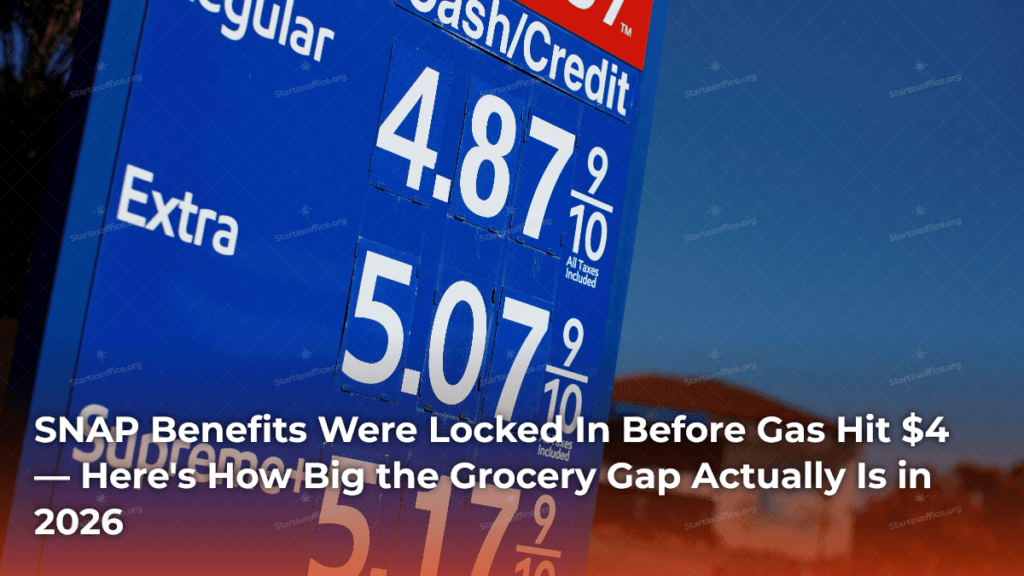
According to AAA, the national average price of regular gasoline was $2.98 per gallon on February 26, 2026 — two days before the conflict began. By April 2, that figure had jumped to $4.06, an increase of more than $1.08 in roughly five weeks.
That’s the fastest sustained gas price surge since summer 2022, when Russia’s invasion of Ukraine pushed the national average to a record $5.02 per gallon. As of early April 2026, California drivers are paying $5.89 per gallon, while states like Oklahoma and Kansas are seeing prices in the $3.25–$3.30 range, according to AAA state-level data.
Diesel Crossed $5 a Gallon and That Hits the Food Supply Chain Harder Than Gasoline
While gasoline prices get the most public attention, diesel is the fuel that actually moves the American food system. The national average price of diesel hit $5.45 per gallon by late March 2026, an increase of more than 40% since the start of the conflict, according to AAA.
That matters for food prices because virtually every step of the food supply chain depends on diesel — from tractors plowing fields, to refrigerated trucks hauling produce, to delivery vehicles stocking grocery store shelves. RSM US chief economist Joe Brusuelas estimated that a 10% rise in diesel alone can push the headline consumer price index up by 0.1 percentage point.
Fuel Makes Up 40–50% of the Variable Cost of Growing and Transporting Food
According to the Center for American Progress, fuel costs account for between 40% and 50% of all variable costs of growing crops in the United States. That includes powering farm equipment, running irrigation systems, and producing the fertilizer that modern agriculture depends on — since fossil fuels are a primary feedstock in fertilizer production, often accounting for up to 80% of manufacturing costs.
When diesel goes from $3.62 to $5.45 in a matter of weeks, those costs don’t stay on the farm. They get passed through at every stage — from processor to distributor to retailer — and ultimately land on the price tag in the grocery aisle.
One-Third of Global Fertilizer Supply Traveled Through the Strait of Hormuz — Until It Didn’t
The countries directly affected by the current conflict — including Iran, Qatar, Saudi Arabia, Bahrain, and the United Arab Emirates — are among the world’s largest fertilizer producers. Approximately one-third of the global fertilizer supply normally transits the Strait of Hormuz.
With that chokepoint effectively closed since early March 2026, fertilizer prices have spiked globally, adding yet another cost pressure to food production. Unlike a temporary fuel price surge, fertilizer shortages can affect crop yields for entire growing seasons — meaning the food price impact could extend well beyond 2026.
What the USDA Economic Research Service Is Projecting for Grocery Prices Through Late 2026
The USDA’s March 2026 Food Price Outlook tells a complicated story. The food-at-home CPI rose 2.4% from February 2025 to February 2026, with several categories significantly outpacing that average.
Here’s where the data gets concerning for SNAP households:
| Food Category | YoY Price Change | 2026 Full-Year Forecast | Impact on SNAP Households |
|---|---|---|---|
| Beef and veal | +13.0% (wholesale) | +5.6% to +25.7% | High — staple protein |
| Sugar and sweets | +9.0% | +6.7% to +13.1% | Medium — baking staples |
| Nonalcoholic beverages | +5.6% | +3.2% to +9.9% | Medium — juice, coffee, milk |
| Farm-level cattle prices | +20.0% | Up to +25.8% | High — drives retail beef |
| Food at home (overall) | +2.4% | –2.3% to +6.0% | Broad baseline pressure |
| Diesel (transportation fuel) | +40%+ since Feb 28 | Volatile — war-dependent | Very high — supply chain |
Source: USDA Economic Research Service Food Price Outlook and Bureau of Labor Statistics CPI data. Figures reflect data through February 2026 and are subject to change.
Worth noting — those USDA forecasts were published in March, based primarily on February data. The full impact of the April gas surge and ongoing Strait of Hormuz disruption is not yet fully reflected in these projections, meaning the actual figures for spring and summer 2026 could come in higher.
The Real Gap — What SNAP Actually Covers vs. What Groceries Actually Cost in April 2026
This is where the numbers tell the sharpest story. The USDA publishes four food plans at different cost levels — Thrifty, Low-Cost, Moderate-Cost, and Liberal — each representing what it costs to feed a household with home-prepared meals.
SNAP benefits are tied to the Thrifty Food Plan, the cheapest of the four. But even the Thrifty plan now costs more than what most SNAP recipients actually receive, because most households have some countable income that reduces the benefit below the maximum.
A Side-by-Side Comparison of SNAP Maximum Allotment vs. Estimated Real Grocery Cost
| Household Size | SNAP Maximum Allotment | USDA Thrifty Plan (Est.) | USDA Moderate Plan (Est.) | Gap vs. Moderate Plan |
|---|---|---|---|---|
| 1 person | $292 | ~$310 | ~$475 | –$183/mo |
| 2 persons | $536 | ~$570 | ~$895 | –$359/mo |
| 3 persons | $785 | ~$770 | ~$1,140 | –$355/mo |
| 4 persons | $994 | ~$950 | ~$1,430 | –$436/mo |
| Note: SNAP max allotments are from USDA FNS FY2026 COLA tables. USDA food plan costs are monthly estimates based on the most recent USDA Cost of Food reports, adjusted for CPI through early 2026. The Moderate-Cost Plan reflects what most American households approximately spend on groceries, according to BLS Consumer Expenditure data. Actual costs vary by region, household composition, and local food prices. | ||||
Source: USDA Food and Nutrition Service FY2026 COLA and USDA Food Plans Monthly Cost of Food Reports. Figures correct as of March 2026 and subject to change.
The gap column tells the story. Even at maximum SNAP benefits — which only households with very low or zero income receive — the allotment falls hundreds of dollars short of what the USDA’s own moderate-cost plan says groceries actually cost.
For the average SNAP recipient receiving $188 per month, the shortfall against the moderate plan is even more dramatic. That’s the equivalent of receiving funding for roughly 12 days of groceries in a 30-day month — and being expected to fill the remaining 18 days through earnings, other programs, or simply going without.
Where the Gap Hits Hardest — Meat, Dairy, and Staples That SNAP Households Depend On Most
Not all grocery categories are rising equally, and the ones climbing fastest tend to be the protein and dairy staples that make up a large share of SNAP household purchases.
Farm-level cattle prices rose 20% year over year through February 2026, driven by a cyclical contraction of the U.S. cattle herd that began before the Iran conflict — and the war-driven diesel surge is now adding transportation costs on top of already elevated production costs. Sugar and sweets jumped 9% year over year, while nonalcoholic beverages — including coffee, juice, and milk substitutes — climbed 5.6%.
The Urban Institute’s county-level analysis found that the maximum SNAP benefit per meal works out to approximately $2.83 in the contiguous United States. The average actual cost of a modestly priced meal exceeded that by $0.57 — a 20% shortfall — and in urban areas, the gap widened to 29%.
The five counties with the largest SNAP-to-meal-cost gaps were New York County (New York), Leelanau County (Michigan), Teton County (Idaho), Teton County (Wyoming), and Marin County (California) — each with a meal price more than 75% higher than the maximum SNAP benefit.
Why SNAP Can’t Adjust Mid-Year — and What the New Federal Law Makes Even Harder
One of the most common misconceptions about SNAP is that benefits automatically adjust when prices rise sharply. They don’t — and under new federal legislation, the mechanism for future adjustments has been significantly constrained.
How the Thrifty Food Plan and the Annual October COLA Lock-In Actually Work
SNAP’s annual benefit cycle works like this — the USDA calculates the cost of the Thrifty Food Plan each June for a reference family of four, using current food prices and the Consumer Price Index. That June cost figure becomes the basis for maximum SNAP allotments for the fiscal year starting October 1, which then remains fixed for the next 12 months.
So the FY2026 allotments now in effect were calculated using June 2025 food price data — nine months before gas hit $4 and well before the Iran conflict disrupted global supply chains. Even if grocery prices surge 10% between now and September 2026, SNAP benefits cannot be adjusted until the next fiscal year begins on October 1, 2026.
The only exception is the Disaster SNAP program (D-SNAP), which provides temporary emergency benefits following a Presidential disaster declaration. However, D-SNAP is not designed to address broad economic conditions like war-driven inflation — it targets specific natural disaster events in defined geographic areas.
The One Big Beautiful Bill Act Froze Any Additional Thrifty Food Plan Adjustment Through October 2027
The legislative picture makes the situation even more challenging for future years. The One Big Beautiful Bill Act, signed into law on July 4, 2025, included a provision requiring that the next reevaluation of the Thrifty Food Plan be no earlier than October 1, 2027 — and that any future reevaluations be held “cost-neutral.”
In practical terms, this means the USDA cannot update the TFP methodology or allow the plan’s cost to increase beyond standard inflation adjustments for the next 18 months, at minimum. The Congressional Budget Office projects that this provision, combined with other SNAP changes in the law, will reduce SNAP spending by approximately $187 billion over 10 years.
That matters because the 2021 TFP reevaluation — which increased SNAP benefits by 21% to better reflect the actual cost of a healthy diet — was the first real structural increase in 45 years. The new law essentially ensures nothing comparable can happen again until late 2027 at the earliest, and even then, any changes must be cost-neutral.
New Work Requirements for Adults 55–64 Add Another Layer of Pressure on Older SNAP Households
The same legislation expanded SNAP work requirements to a new age group. Previously, Able-Bodied Adults Without Dependents (ABAWD) time limits — which restrict SNAP benefits to three months in a three-year period for individuals not meeting work requirements — applied to adults ages 18–54.
Under the new law, adults ages 55–64 without dependent children must now work at least 20 hours per week or participate in an approved training program to maintain SNAP eligibility beyond three months. The Congressional Budget Office estimated that approximately 1.2 million people nationwide could be affected.
For older adults who may face age-related employment barriers, health limitations that don’t qualify for disability exemptions, or limited access to approved training programs, this creates a compounding challenge — reduced earning capacity combined with SNAP income limits that haven’t kept pace with real-world costs.
What SNAP Households Can Actually Do Right Now to Stretch Benefits Further
While the structural gap between SNAP allotments and grocery costs is a policy issue that individual households can’t solve alone, there are several concrete steps that may help bridge the shortfall in the near term.
Maximizing SNAP Deductions — Medical, Shelter, and Dependent Care Costs That Lower Countable Income
The SNAP benefit formula subtracts 30% of a household’s net income from the maximum allotment. That means every deduction that lowers net income results in a higher monthly benefit — and many eligible deductions go unclaimed.
For fiscal year 2026, allowable SNAP deductions include a standard deduction of $209 for households of one to three people, a 20% earned income deduction, actual dependent care costs, and an excess shelter deduction capped at $744 per month. Households with elderly (60+) or disabled members can also deduct out-of-pocket medical expenses exceeding $35 per month — with no cap.
Reporting all eligible deductions to the state SNAP office is one of the most direct ways to increase monthly benefits. A household paying $1,200 per month in rent and utilities, for example, may qualify for a significantly higher shelter deduction than what’s currently reflected in the benefit calculation.
Stacking Programs — WIC, TEFAP, School Meals, GusNIP, and Community-Based Options
SNAP was never designed to be the sole source of food assistance for low-income households, and several federal and state programs can supplement it.
The Special Supplemental Nutrition Program for Women, Infants, and Children (WIC) provides specific foods for pregnant women, new mothers, and children under five — and SNAP eligibility often qualifies a household automatically. The Emergency Food Assistance Program (TEFAP) supports food banks and pantries nationwide with USDA commodities. The National School Lunch and School Breakfast Programs provide free and reduced-price meals, and SNAP eligibility typically means automatic qualification.
The Gus Schumacher Nutrition Incentive Program (GusNIP), formerly known as the Food Insecurity Nutrition Incentive Program, provides matching funds when SNAP is used to purchase fruits and vegetables — effectively doubling the value of SNAP dollars spent on produce at participating farmers markets and grocery stores. Information about local GusNIP programs is available through nutrition.gov.
For households also receiving Social Security payments, coordinating the timing of benefit deposits with grocery shopping schedules can help with household budgeting — though it doesn’t change the total amount available.
Finding Local Food Banks, SNAP Match Programs, and Emergency Assistance Through 211
Community resources can help fill gaps that federal programs don’t fully cover. The nationwide 211 helpline (dial 2-1-1 or visit 211.org) connects callers with local food banks, emergency food distribution sites, utility assistance, and other services available in the caller’s ZIP code.
Feeding America, the nation’s largest domestic hunger-relief organization, operates a network of more than 200 food banks and 60,000 food pantries. Many food banks do not require SNAP enrollment or proof of income to access services.
Additionally, many states and localities operate their own SNAP supplemental programs. Some states have adopted Broad-Based Categorical Eligibility (BBCE), which raises gross income limits and eliminates asset tests — potentially qualifying more households for benefits. Each state administers SNAP differently, so contacting the local state agency is the most reliable way to determine what’s available.
When to Contact a State SNAP Office or Request a Fair Hearing if Benefits Seem Wrong
If a SNAP household has experienced a significant change in circumstances — such as job loss, increased rent, new medical expenses, or the addition of a household member — reporting those changes promptly to the state SNAP office can trigger a benefit recalculation mid-certification.
SNAP recipients also have the legal right to request a fair hearing if a benefit determination seems incorrect. The USDA Food and Nutrition Service provides information on eligibility rules, and each state maintains a process for appealing benefit decisions. Requesting a hearing does not reduce or stop current benefits while the appeal is pending.
Even if Gas Prices Drop Tomorrow, Grocery Inflation Won’t Follow for Months
There’s a common assumption that if the conflict ends and gas prices fall, grocery prices will come down quickly too. The historical record suggests otherwise.
The Lag Effect — Why Food Prices Stay High Long After Fuel Prices Fall
Food price inflation operates on a well-documented lag. When fuel and input costs rise, food producers, processors, and retailers adjust their prices upward relatively quickly — typically within four to eight weeks. But when costs fall, those price reductions filter through much more slowly, often taking three to six months to reach the grocery shelf.
After Russia’s invasion of Ukraine in February 2022, gas prices peaked in June at over $5 per gallon nationally and then declined sharply through the second half of the year. But food-at-home inflation didn’t peak until August 2022 at 13.5% year over year and didn’t return to single digits until mid-2023.
The current situation carries additional structural risks. The cattle herd contraction, global fertilizer supply disruption, and energy infrastructure damage in the Persian Gulf region are not problems that resolve the moment hostilities end. FMI — The Food Industry Association noted in February 2026 that even without the x-factor of the Iran conflict, structural pressures from labor shortages, energy costs, and weather risks were already expected to keep food prices elevated.
The Earliest SNAP Allotments Can Increase Is October 2026 — and Even That Isn’t Guaranteed
The next opportunity for a SNAP benefit adjustment is the FY2027 COLA, which will be based on the Thrifty Food Plan cost calculated in June 2026 and take effect October 1, 2026. If food prices remain elevated through June, that calculation should reflect at least some of the 2026 price surge.
However, the One Big Beautiful Bill Act’s cost-neutral requirement for future TFP reevaluations means the USDA cannot make structural changes to the TFP methodology that would allow benefits to increase beyond standard CPI-based inflation adjustments. The only increases will come from the automatic monthly CPI update to the existing TFP market basket — not from any reassessment of whether the TFP adequately reflects the real cost of a nutritious diet.
In the meantime, households facing rising health insurance costs alongside higher food and gas prices are experiencing a cost-of-living compression that no single benefit program was designed to fully address.
Protecting Against SNAP-Related Scams and Fraud
Periods of economic stress and benefit uncertainty tend to produce an increase in scams targeting benefit recipients. SNAP households should be aware of several common fraud tactics and know where to report suspicious activity.
EBT card skimming — in which criminals install devices on card readers at grocery stores or ATMs to steal card numbers and PINs — has been a growing problem nationwide. If unauthorized charges appear on an EBT account, the state SNAP office should be contacted immediately to freeze the card and request a replacement.
Scam calls, texts, or emails claiming to offer “extra SNAP benefits,” “emergency SNAP payments,” or requesting personal information to “update EBT accounts” are not legitimate. The USDA and state SNAP agencies do not contact recipients by phone or email to request Social Security Numbers, EBT card numbers, or PINs.
Suspicious activity related to SNAP fraud can be reported to the USDA Office of Inspector General Hotline at 1-800-424-9121 or online at usda.gov/oig. General fraud and scam complaints can also be filed with the Federal Trade Commission at reportfraud.ftc.gov. For identity theft concerns, the FTC’s identity theft reporting tool is available at identitytheft.gov.
Disclaimer: The information on startaxoffice.org is for general informational purposes only and does not constitute tax, legal, or financial advice. SNAP eligibility rules, benefit amounts, income limits, and program requirements change frequently and vary by state. Always consult a local SNAP office, qualified social worker, or legal aid organization before making decisions about government benefits. This site is not affiliated with the USDA, any state SNAP agency, the IRS, or any government entity. Figures cited in this article are based on USDA FNS FY2026 COLA data, Bureau of Labor Statistics CPI reports, AAA fuel price data, and USDA ERS Food Price Outlook projections available as of April 2026 and are subject to change.
Closing
The gap between SNAP allotments and actual grocery costs in spring 2026 is not a hypothetical policy debate — it’s a daily arithmetic problem facing 42 million Americans who are watching prices climb at the store while the number on the EBT card stays the same. The Iran war’s impact on fuel prices didn’t just raise the cost of driving; it set off a chain reaction that is now hitting the food supply at every stage, from fertilizer production to the final mile of delivery.
No single program, policy change, or coping strategy can fully close that gap overnight. But understanding how the system works — the annual COLA lock-in, the Thrifty Food Plan methodology, the deductions that can increase monthly benefits, and the supplemental programs available beyond SNAP — gives households a clearer picture of what options exist and where to find help.
For households navigating this period, contacting the state SNAP office to ensure all deductions are properly reported, connecting with local food banks through 211, and exploring nutrition incentive programs like GusNIP are practical steps that can make a measurable difference while the broader policy picture continues to develop. A free tax calculator can also help households estimate total tax liability and plan finances more effectively.
Sources
- USDA Food and Nutrition Service — SNAP COLA Information
- USDA Economic Research Service — Food Price Outlook
- USDA Food Plans — Monthly Cost of Food Reports
- Bureau of Labor Statistics — Consumer Price Index February 2026
- Center on Budget and Policy Priorities — SNAP Eligibility and Benefits Guide
- Urban Institute — Does SNAP Cover the Cost of a Meal in Your County?
- AAA — State Gas Price Averages
- Center for American Progress — War in Iran and Fuel Prices
- FMI — Food Price Inflation Outlook 2026
Frequently Asked Questions
1 Why can’t SNAP benefits adjust when grocery prices go up mid-year?
2 How much does the average SNAP recipient get per day for food in 2026?
3 How did the Iran war affect food prices in the United States?
4 What is the maximum SNAP benefit for a family of four in 2026?
5 What did the One Big Beautiful Bill Act change about SNAP?
6 What can SNAP recipients do to increase monthly benefits right now?
7 When will SNAP benefits increase next?

Dian Saputri is a benefits and tax credits writer at startaxoffice.org specializing in government assistance programs, Social Security, tax credits, and financial literacy for American families. A Certified Financial Education Instructor (CFEI) and former IRS Volunteer Income Tax Assistance (VITA) program volunteer, Dian brings a deep understanding of how tax policy intersects with everyday household finances. Her coverage spans the Earned Income Tax Credit, Child Tax Credit, SNAP, Medicaid, and unemployment benefits — always grounded in official data from IRS.gov, SSA.gov, and Benefits.gov. Dian is passionate about making complex benefit eligibility rules accessible to the people who need them most.